Africa’s food and water security now national and geopolitical priorities

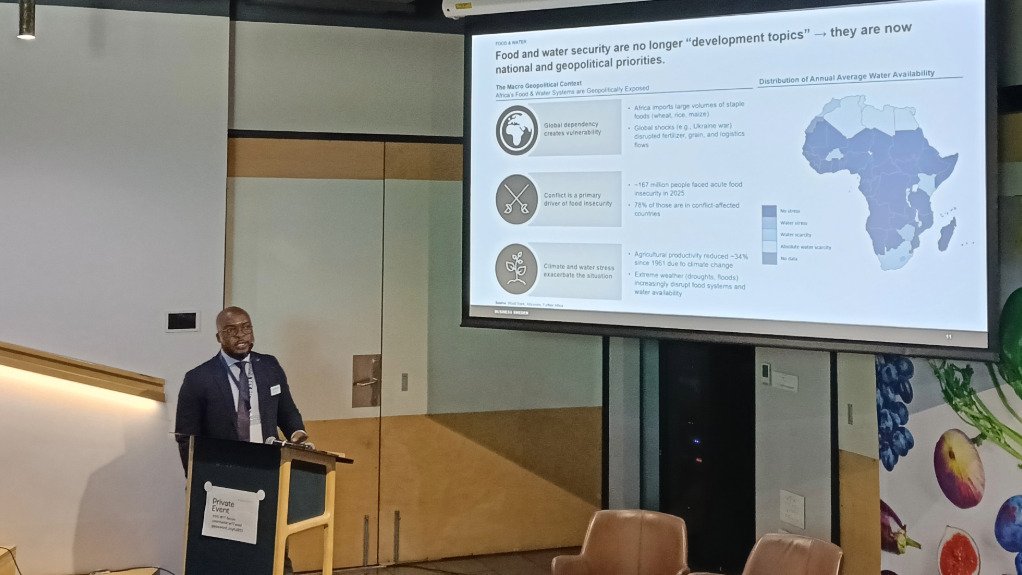


Africa’s food and water security, along with resilient local value chains – water, agriculture, processing – are no longer just development topics, they have become national and geopolitical priorities across governments and investors, said Business Sweden strategy and business development Middle East and Africa project manager Kudakwashe Koke.
Speaking at a high-level Thought Leadership Forum hosted by Alfa Laval, in partnership with Business Sweden, he said that the continent’s global dependency created vulnerability, as Africa imported large volumes of staple foods, such as wheat, rice and maize, and was experienced global shocks, including wars, which disrupted fertiliser, grain and logistics flows.
The forum, which convened Swedish and South African government representatives, industry leaders and technical experts, explored how Africa stands at a pivotal moment where food security, pharmaceutical self-sufficiency and water resilience have become urgent priorities shaping the continent’s industrial future.
Conflict is a primary driver of food security, with 167-million people – 78% in conflict-affected countries – having faced acute food insecurity in 2025.
Further, climate and water stress exacerbate the situation, with agricultural productivity reducing 34% since 1961 owing to climate change, and extreme weather, droughts and floods increasingly disrupting food systems and water availability.
“The [challenges] are now national and geopolitical priorities . . . it is now the central discussion around government and the public sector working together with the private sector.”
Africa still remains globally vulnerable as a net importer dependent on the global value chains.
Upwards of $50-billion is spent every year on food imports, while 300-million people lack safe water access and millions live within the boundaries of undernourishment, yet the continent has 60% of the world's uncultivated arable land that could be used for food production.
“There is quite a lot of focus from a policy perspective where governments are now pushing in terms of trying to create and support local value chains,” he noted, pointing out that this could be through policy implementation and investments into local production chains that could support farmer supply in the regions.
Strong policy frameworks would mobilise investment and strengthen food security financing, Koke said, highlighting the need to create an enabling policy environment that attracted investment and reduced financial risks; allocate adequate public resources to agriculture, nutrition, rural infrastructure and extension services; address structural inequalities; and coordinate climate adaptation, social protection and conflict-sensitive interventions to build resilient food systems.
Further actions include implementing the Comprehensive Africa Agricultural Development Programme, or CAADP, and national food system strategies with measurable targets and accountability; supporting access to finance through guarantees, insurance schemes and public-private partnerships; and strengthening land, trade and regulatory frameworks to improve agricultural productivity and market efficiency.
During his presentation, Koke noted that increasing policies that support facilitation and incentives had led to direct increases in regional foreign direct investment (FDI), with Africa recording a 75% rise in FDI between 2023 and 2024 driven by a mega infrastructure project in Egypt. Excluding that, flows still grew 12% supported by investment reforms and improved facilitation across the continent.
Africa, boasting 18 of the worlds 30 fastest-growing economies, a $2.8-trillion regional GDP and 3.9% GDP growth rate in 2025, presents an ideal market for growth, with natural, human, financial and business capital driving regional market growth.
Africa is home to 30% of global mineral reserves and could capture over 10% of the $16-trillion in revenue from key green minerals by 2030, while the continent’s median age of 19 represents a demographic dividend that could add $47-billion to Africa’s GDP through improved workforce participation.
Pension fund assets have grown to $1.1-trillion and formal remittances could reach $500-billion by 2035 if transfer costs are reduced, while the full implementation of the African Continental Free Trade Area Agreement could increase exports by $560-billion and boost continental income by $450-billion by 2035.
In addition, Africa’s population has grown more than sixfold since 1950, an increase of 1.3-billion people, and, with a continuing population expansion, will add nearly one-billion total residents, rising to 2.5-billion, by 2050. Africa’s working age population will increase from 660-million in 2024 to 1.25-billion in 2050.
The continent is also the fastest-urbanising region globally, with urban populations growing at an average annual rate of 3.5%, with the expectation that this will increase from a 43% urbanisation rate to a 60% urbanisation rate.
Urbanisation consistently correlates with higher regional productivity, job creation and better socioeconomic outcomes compared with rural averages.
While these trends present significant opportunities, it also brings many challenges, including infrastructure pressures, as unprecedented spatial expansion will push total urban footprints to 175 000 km2 by 2050, straining housing, transport and basic municipal services, and the development of informal settlements, with projections indicating high vulnerability to resource strain, with proactive long-term investments needed in climate-resilient and inclusive planning.
Article Enquiry
Email Article
Save Article
Feedback
To advertise email advertising@creamermedia.co.za or click here

Projects

Latest Multimedia



Showroom

Mitsubishi Chemical Advanced Materials South Africa (Pty) Ltd is a leading manufacturer of high-performance engineering plastics for the mining...
VISIT SHOWROOM
ALBIS FLANGES — founded in 1965 — is a petro-chemical approved manufacturer of flanges and fittings in most grades of steel, listed with Sasol,...
VISIT SHOWROOM



Press Office
Announcements
What's On
Subscribe to improve your user experience...
Option 1 (equivalent of R125 a month):
Receive a weekly copy of Creamer Media's Engineering News & Mining Weekly magazine
(print copy for those in South Africa and e-magazine for those outside of South Africa)
Receive daily email newsletters
Access to full search results
Access archive of magazine back copies
Access to Projects in Progress
Access to ONE Research Report of your choice in PDF format
Option 2 (equivalent of R375 a month):
All benefits from Option 1
PLUS
Access to Creamer Media's Research Channel Africa for ALL Research Reports, in PDF format, on various industrial and mining sectors
including Electricity; Water; Energy Transition; Hydrogen; Roads, Rail and Ports; Coal; Gold; Platinum; Battery Metals; etc.
Already a subscriber?
Forgotten your password?
Receive weekly copy of Creamer Media's Engineering News & Mining Weekly magazine (print copy for those in South Africa and e-magazine for those outside of South Africa)
➕
Recieve daily email newsletters
➕
Access to full search results
➕
Access archive of magazine back copies
➕
Access to Projects in Progress
➕
Access to ONE Research Report of your choice in PDF format
RESEARCH CHANNEL AFRICA
R4500 (equivalent of R375 a month)
SUBSCRIBEAll benefits from Option 1
➕
Access to Creamer Media's Research Channel Africa for ALL Research Reports on various industrial and mining sectors, in PDF format, including on:
Electricity
➕
Water
➕
Energy Transition
➕
Hydrogen
➕
Roads, Rail and Ports
➕
Coal
➕
Gold
➕
Platinum
➕
Battery Metals
➕
etc.
Receive all benefits from Option 1 or Option 2 delivered to numerous people at your company
➕
Multiple User names and Passwords for simultaneous log-ins
➕
Intranet integration access to all in your organisation